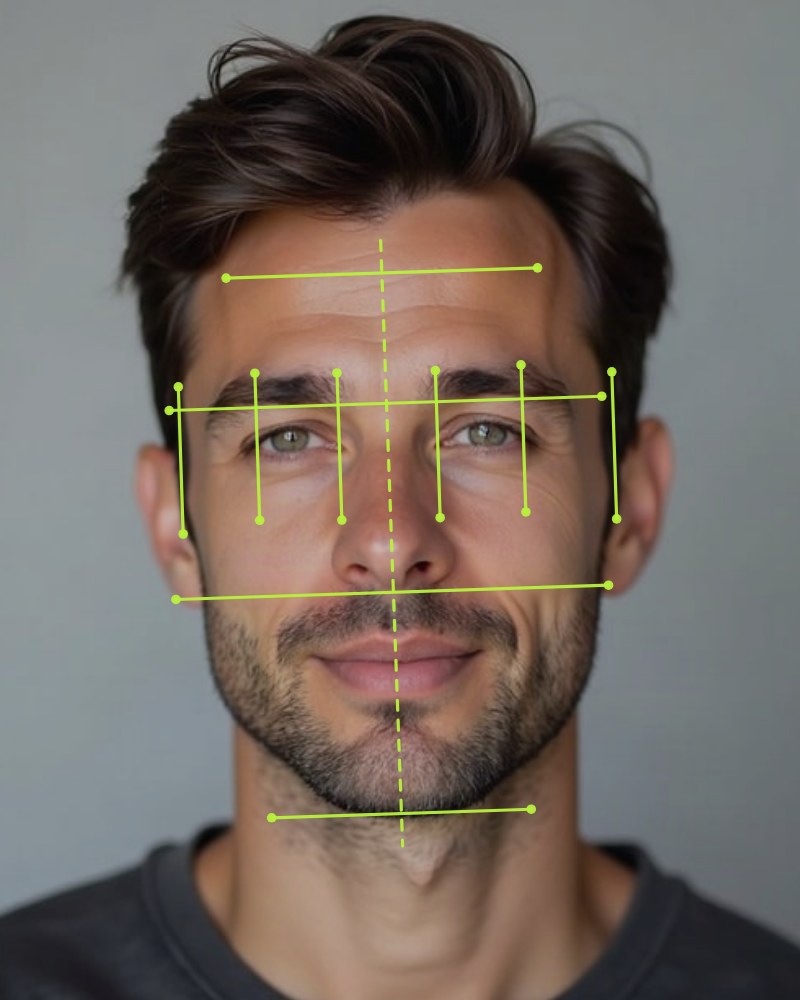
What a square face shape looks like
A square face has a clear frame. The jaw turns a corner below each ear instead of curving, the chin is broad and fairly flat across the bottom, and the forehead, cheekbones and jaw line up at similar widths, so the sides run nearly straight down. The face is only a little longer than it is wide.
A strong jaw photographs well in side light, because the corner catches it, which is one reason the shape is so common in fashion photography for every gender. Softer squares, where the corner is there but rounded, are very common and often get called “square-ish oval”.
How to tell if you have a square face shape
In this test the square profile has the widest jaw of the six: 0.92 of the cheekbone width, against 0.90 for the middle of the calibration faces. Its chin angle is 131.8° (middle 126.0°), the broadest of the six; its forehead is slightly wide at 0.86; and its length-to-width ratio is 1.15, on the short side.
The jaw row in your result is the one to watch. Jaw width is measured between the jaw corners just below the ears, so hair over those corners can hide them: pull it back for the photo. A full beard can hide where the corner really is, so treat the jaw number as approximate if you have one.
Mirror check: trace your outline on a steamy bathroom mirror with a fingertip, keeping your head still. If the traced shape looks more like a rectangle with rounded corners than an egg, and the bottom is flat, square is likely.
Square, round or oblong?
The profile nearest to square in this test is round. Both are short for their width; the difference is the corner. Round’s jaw sits at 0.90, square’s at 0.92, and on a round face the line from cheek to chin is one smooth curve.
A square face that is clearly longer than wide is often called rectangle in styling guides. This test has no separate rectangle shape: such faces land on oblong (length 1.26) with a wide jaw, and the runner-up line will often say square. Read the oblong face shape page if that sounds like you.
Common myths about the square face shape
- “A square face is a masculine face.” Jaw width varies in every gender, and a square outline is common on women, including many fashion models.
- “Square faces need softening.” Many styles lean into the angles on purpose: blunt bobs, slicked-back hair, sharp frames. Softening is one option among several.
- “A wide jaw means a big chin.” They are separate: jaw width is measured at the corners, chin shape at the front. Some square faces have a small chin.
Hair, glasses and makeup ideas for a square face
You can either round off the corners or play them up. Both work:
- Hair: soft layers that start around the jaw, side-swept fringes, waves and loose curls round off the corners; a sleek long cut adds length. To play up the angles, try a blunt bob at the jaw or a slicked-back style. Short cuts with a textured top and tapered sides suit the frame. For a ranking built from your own jaw width, use the hairstyle finder.
- Glasses: round and oval frames contrast with the jaw; browline frames draw attention upward. Frames much narrower than the cheekbones can look small.
- Makeup: blush on the apples of the cheeks and a little highlight down the centre of the face shift focus to the middle. Contour along the jaw corners is optional.
- Beards: stubble or a short boxed beard keeps the jawline visible; a beard fuller at the chin than at the sides lengthens the face.
What a square face looks like in everyday terms
Picture the classic action-film or catwalk jaw: a face almost as wide at the jaw as at the cheekbones, a corner you could set a ruler against, and a chin that looks flat at the bottom. That is the square outline, and it is equally at home on soft, smiling faces.
See how the jaw compares with the rest of your face in the free attractiveness test, or check its closest neighbour on the round face shape page.