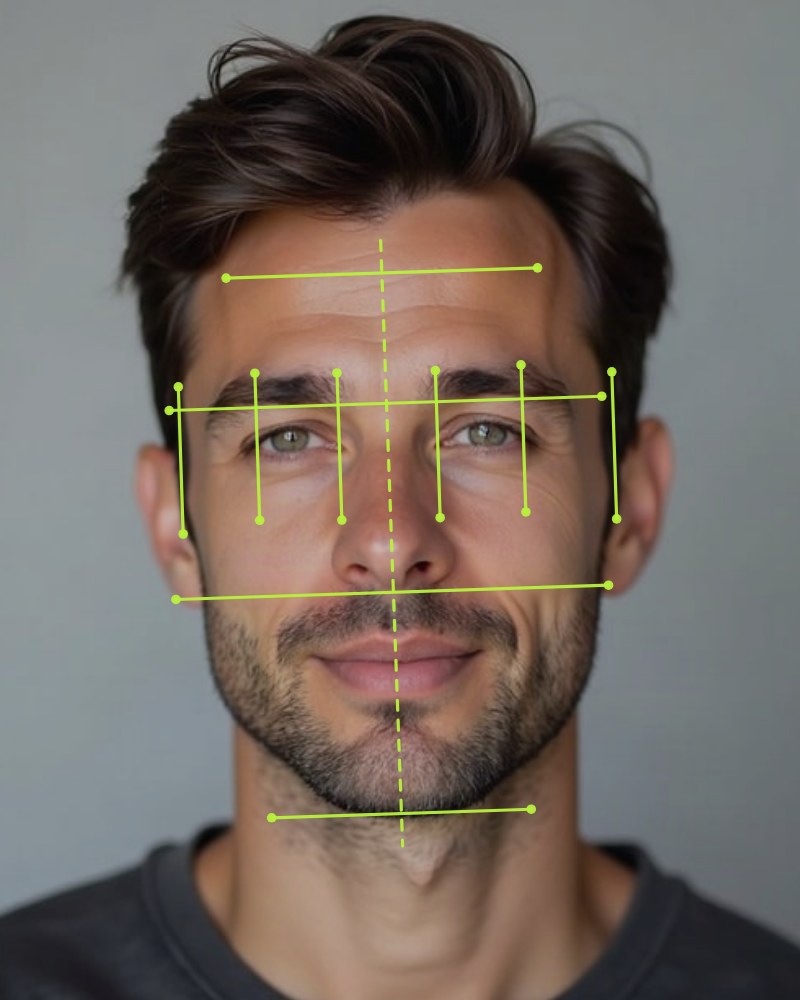
What high cheekbones are
The cheekbone runs from under the eye back toward the ear. Where its most prominent point sits varies from face to face. When that point is high, close to the level of the lower eyelid, light catches the top of the cheek and the area below falls into shadow: the classic sculpted look. When it sits lower, nearer the level of the nose base, the cheek looks fuller and smoother.
Two different things get called high cheekbones: height, meaning how far up the most prominent point sits, and prominence, meaning how far the cheekbones stand out past the temples and jaw. The look people admire usually involves both, and in photos the two are easy to mix up.
How to tell if you have high cheekbones
Height is a mirror check, because a front photo cannot measure it. It takes about two minutes:
- Stand facing a mirror under overhead light, with your hair pulled back and a relaxed face.
- Press your fingertips into each cheek just below the outer corner of the eye until you feel the bony ridge.
- Follow the ridge outward to the point where it stands out most.
- If that point sits closer to your lower eyelid than to the bottom of your nose, your cheekbones are high; around the nose base, they are low; in between is medium.
- Smiling lifts the cheeks and makes everyone’s cheekbones look higher, so keep a neutral face. Sucking the cheeks in gently shows the shadow line clearly.
What the free test measures: prominence
The test reads the width across your cheekbones, then your temples, forehead and jaw as a share of it. In this test’s calibration faces, the middle 60% had temples between 0.92 and 0.95 of the cheekbone width and a jaw between 0.88 and 0.91. Lower numbers than that mean cheekbones that stand out more than most of the set; higher ones mean a straighter side outline.
The test does not estimate height from the photo. The point it uses for cheekbone width sits at the widest part of the outline, not on the bone itself, so any height number drawn from it would be a guess. That is why height is the mirror check above.
High cheekbones vs low cheekbones
Low cheekbones are just as normal. They tend to go with fuller, smoother cheeks and a softer look in flat light. High cheekbones give stronger contrast in photos and in side light.
Cheekbones also shape your face shape result. Prominent cheekbones with a narrow forehead and jaw are the core of the diamond face shape; with a broad forehead they lean toward a heart shaped face.
Common myths about cheekbones
- “You either have high cheekbones or you do not.” Height is a scale, and many faces are medium.
- “Facial exercises raise your cheekbones.” Exercises cannot move bone. The results promised online usually come from lighting, angle or expression.
- “High cheekbones are what makes a face good-looking.” They make a face photograph with more contrast. Faces with low cheekbones and full cheeks are admired just as often.
- Many search results on this topic come from clinics. This page does not recommend fillers, implants or any other procedure.
Makeup and styling around the cheekbones
Whatever their height, a few small choices bring the cheekbones forward:
- Contour: find the hollow under the bone (the mirror check shows you where) and blend a soft line along it from the ear toward the mouth, stopping below the outer corner of the eye. Highlight goes on top of the bone.
- Blush: on high cheekbones, sweep it along the bone toward the temple; on medium or low ones, place it slightly above the apples to add lift.
- Hair: face-framing layers that start at cheekbone height draw the eye there; tucking hair behind the ears shows the width.
- Glasses: frames whose lower edge sits above the cheekbones keep them visible; large frames resting on the cheeks hide them.
- Photos: soft light from one side, a little above, brings out the shadow line under the cheekbone.
What high cheekbones look like in everyday terms
Picture a fashion portrait: a bright ridge just under the eyes and a soft shadow running down toward the mouth. That is the high-cheekbone outline. Most faces sit somewhere softer, and good light alone gets a long way toward it.
Measure the rest of your proportions in the free attractiveness test, or see all four widths in the face shape detector.