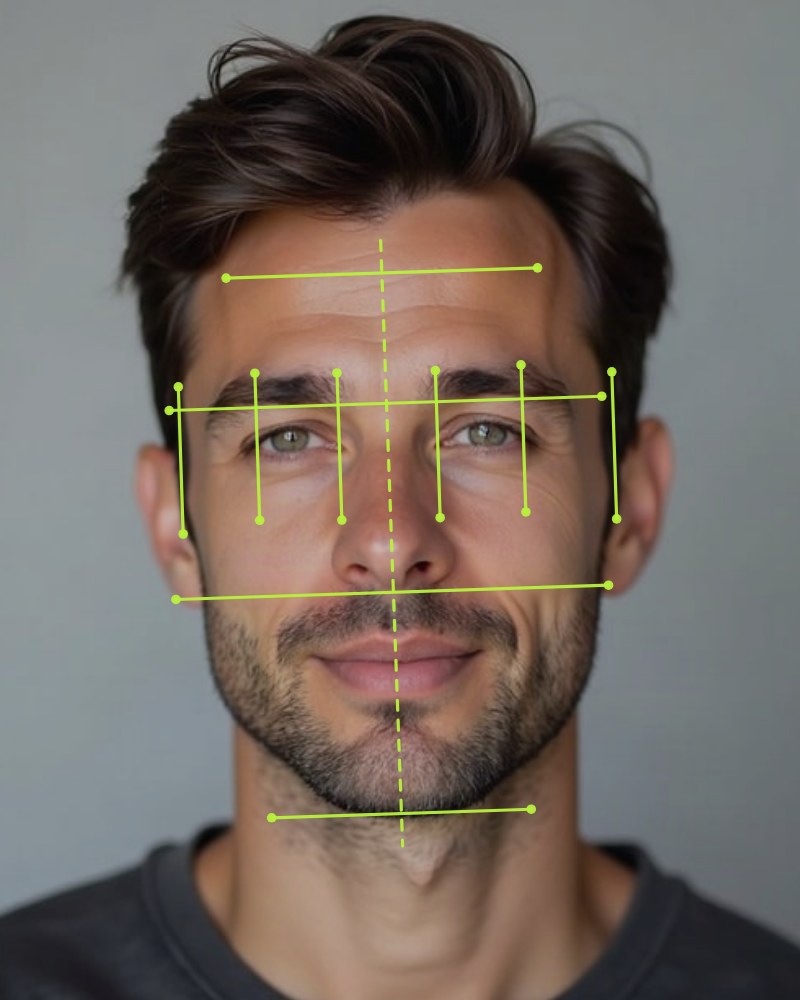
What an oval face shape looks like
Think of an egg standing on its narrow end, then soften it. The face is longer than it is wide, but not by much. The widest line runs across the cheekbones, and from there the outline narrows gently in both directions, toward the forehead and toward the jaw, ending in a chin that is curved rather than flat or pointed. No single part dominates the outline, which is why oval gets described as balanced.
Oval is the shape most face-shape charts use as their reference point, so it gets talked about as the “ideal”. That reputation comes from hairdressing convention, not from any finding that oval faces look better. It mostly means oval is the easiest outline to describe the others against.
How to tell if you have an oval face shape
The test reads four numbers off your photo and compares them with six shape profiles. The oval profile sits at a length-to-width ratio of 1.21, a forehead 0.85 of the cheekbone width, a jaw 0.89 of the cheekbone width and a chin angle of 124.9°. The middle of the test’s calibration faces is 1.19, 0.85, 0.90 and 126.0°. So an oval face reads a little longer than the middle, with a slightly narrower jaw and a slightly sharper chin; the forehead sits right on the middle.
Those differences look tiny as raw numbers, and they are: face shapes differ by a few percent, not by a lot. That is why the test weighs each number against how much faces normally vary, and your shape is whichever profile your four numbers land nearest. Length is measured from the top of the tracked forehead, not the hairline, which the camera model cannot see; every profile is measured the same way.
Without a camera: pull your hair back, face a mirror straight on and ask three questions. Is the face visibly longer than wide, without looking long? Are the cheekbones the widest point, with the jaw tapering in below them? Is the chin curved rather than flat or pointed? Three yeses point to oval.
Oval, oblong or diamond? The shapes it gets mixed up with
In this test the profile nearest to oval is oblong, then diamond. Oval and oblong share the same tapering outline; the difference is length. The oblong profile sits at 1.26 against oval’s 1.21, and its jaw stays wider (0.90), so the sides run straighter. If people keep telling you that you have a long face, read the oblong face shape page.
Oval and diamond differ at the top. A diamond face has a clearly narrower forehead (0.82 of the cheekbones, against oval’s 0.85) and a more pointed chin, so the cheekbones stand out as a peak rather than a gentle curve. “Am I oval or diamond?” is one of the most common questions on face-shape forums, and the honest answer is often “between the two”. That is why the result always names a runner-up.
Common myths about the oval face shape
- “Oval is the perfect face shape.” It is the reference shape in styling guides, nothing more. All six shapes on this site are normal ways for a face to be.
- “Everything suits an oval face.” There are fewer outline effects to balance, but hair texture, your features and your own taste still decide what works.
- “Your shape never changes.” Bone structure is stable in adults, but weight, age and even how close the camera is can move a borderline face from oval to a neighbour.
- “A tape measure settles it.” Tape and photo measure similar widths, and both struggle with a face that sits between two shapes.
Hair, glasses and makeup ideas for an oval face
Because the outline already tapers gently, an oval face can go in most directions, and the useful question is what you want to show off. Some starting points:
- Hair: almost any length works. Long layers show the cheekbones; a blunt bob at chin level adds width low down; a centre part stays symmetric while a side part adds movement. If your result leans toward oblong, go easy on height at the crown, which makes the face read longer. To rank the six cuts against your own length and jaw, try the hairstyle finder.
- Glasses: frames about as wide as the cheekbones keep the proportions. Rectangular and geometric frames add a little structure; very small frames can look lost.
- Makeup: there is little to balance, so contour, if you use it at all, can simply bring out the cheekbones. Blush on the apples swept up toward the temples follows the oval’s own line.
What an oval face looks like in everyday terms
Picture a face where nothing in the outline grabs attention: cheekbones a little wider than a softly rounded jaw, a forehead in proportion, and a face just longer than it is wide. It is the outline most hairstyle charts draw first, and the one the others are described against.
For the full picture of your proportions, take the free attractiveness test, or compare oval with its neighbours on the diamond face shape and round face shape pages.