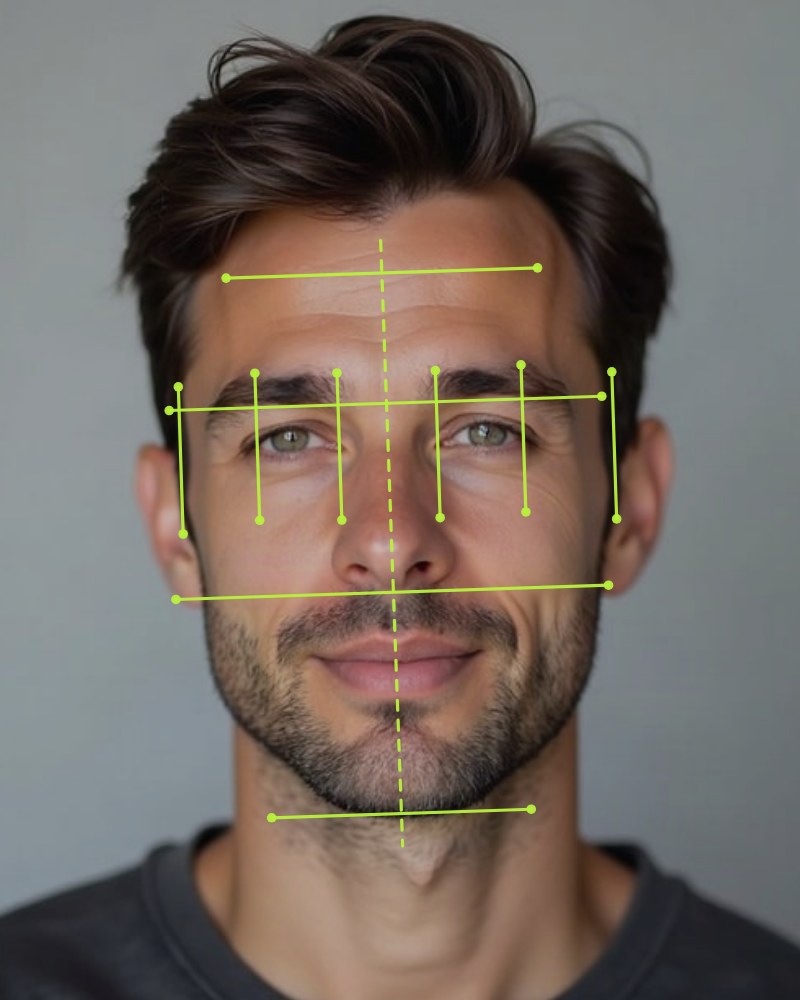
What a diamond face shape looks like
On a diamond face the outline peaks at the cheekbones. Above them the temples and forehead narrow; below them the jaw narrows too, ending in a chin that comes to a point. The face is a little longer than it is wide. Styling guides often call it the rarest shape, although nobody has a reliable count.
Diamond faces show their bone structure clearly and tend to look sculpted in side light, with a bright ridge along the cheekbone and a shadow below it.
How to tell if you have a diamond face shape
The diamond profile has the narrowest forehead of the six in this test: 0.82 of the cheekbone width, against 0.85 for the middle of the calibration faces. Its jaw is narrow too (0.88; middle 0.90), its chin is pointed at 122.8° (middle 126.0°), and its length is 1.20, slightly long.
The forehead row decides most diamond results. Forehead width is taken across the upper forehead, so a fringe or hair worn forward over the temples can hide the true edge. Pull your hair right back for the photo.
Mirror check: put a fingertip on each cheekbone at its widest, then move up to the temples and down to the jaw corners. If your fingers move clearly inward in both directions and the chin narrows to a point, diamond fits.
Diamond or oval? Diamond or heart?
The profile nearest to diamond in this test is oval. Both are widest at the cheekbones; diamond narrows faster above and below. A face between the two gets both names in the result, and advice for either will work. This is the question face-shape forums argue about most, and “both, a little” is a perfectly good answer.
Heart comes next. Heart and diamond share the narrow jaw and pointed chin but differ at the forehead: the heart profile sits at 0.87, diamond at 0.82. A heart face is broad up top; a diamond face is narrow at the temples. See the heart shaped face page for the other side of the comparison.
Common myths about the diamond face shape
- “Diamond faces are so rare the test must be wrong.” There is no reliable count of face shapes, and a result near a boundary is normal. Check the runner-up.
- “Diamond means sharp, harsh features.” The outline is angular at the cheekbones; the features inside it can be as soft as anyone’s.
- “Diamond is just another word for heart.” They share the lower half only. The forehead tells them apart.
Hair, glasses and makeup ideas for a diamond face
Ideas for diamond faces add fullness where the face is narrower, at the forehead and the jaw, or simply show off the cheekbones:
- Hair: side-swept or curtain bangs, chin-length bobs and waves that start below the cheekbones. Tucking hair behind the ears shows the cheekbones; very short sides with height on top make them read even wider. The hairstyle finder names three cuts for a narrow forehead and jaw, with your numbers.
- Glasses: oval, rimless and cat-eye frames, or frames with a strong browline, add width at the top. Very wide frames can hide the cheekbones.
- Makeup: highlight the centre of the forehead and the chin; place blush just below the widest point of the cheekbone rather than on it.
- Beards: a fuller beard at the chin and jaw adds width where the face narrows.
What a diamond face looks like in everyday terms
Picture strongly sculpted cheekbones, narrow temples and a slim, pointed chin: the face that looks most dramatic in a black-and-white portrait.
Read more about the cheekbones themselves on the high cheekbones page, or compare diamond with oval on the oval face shape page.