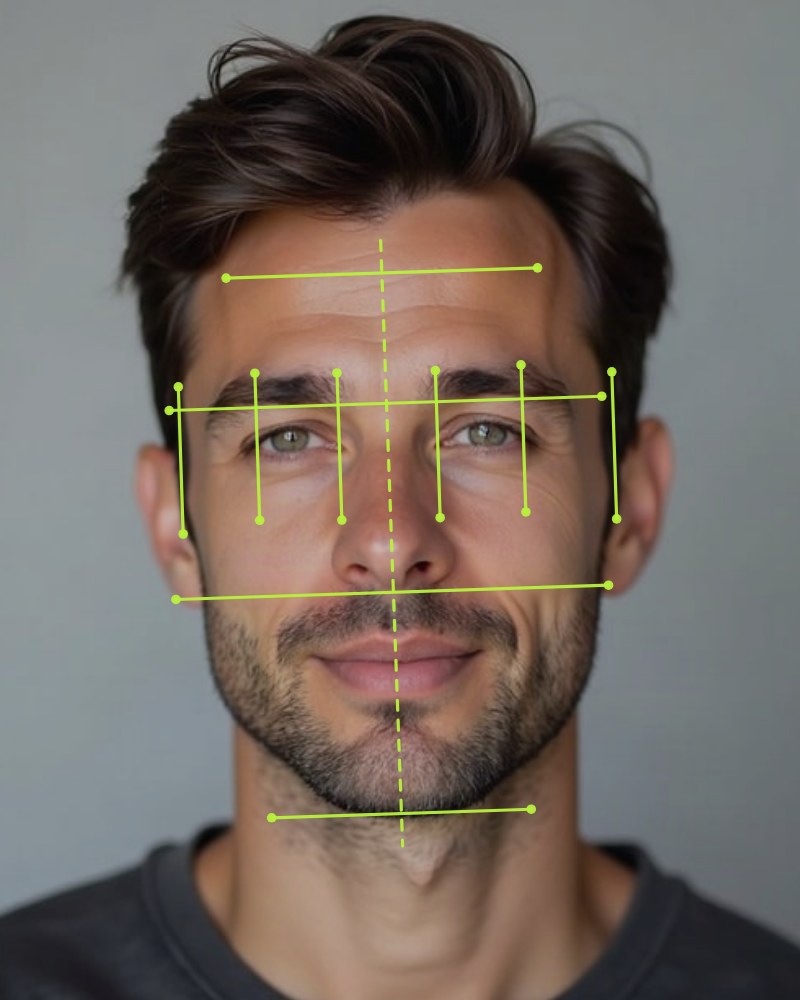
What a round face shape looks like
A round face has no strong corners. Length and width are close, the cheeks are the fullest part, and the jaw curves into the chin rather than turning at an angle below the ear. Of the six shapes it is the nearest to a circle, though in real faces “round” still means a little longer than wide.
A round face often reads as warm and approachable, which is one reason so many cartoon characters are drawn with one. It is an outline, not a weight: plenty of slim people have round faces, and plenty of fuller faces are square or oval underneath.
How to tell if you have a round face shape
The round profile in this test has the shortest length-to-width ratio of the six, 1.13; the middle of the calibration faces is 1.19. Its chin angle is 130.8°, wider than the middle’s 126.0°, which means a broad curve at the bottom rather than a point. Forehead (0.85) and jaw (0.90) are close to the middle.
So a round result comes mostly from two numbers: a short face for its width and a wide chin angle. If the test says round and you are not sure, look at those two rows in your result first. A close second shape usually differs from round on exactly one of them.
Mirror check: pull your hair off your face and relax your expression. If the cheeks are the widest part, you cannot find a clear corner on the jaw, and the face looks almost as wide as it is tall, round is likely.
Round or square? Telling the two apart
The profile nearest to round in this test is square, and the two are close: they differ mainly at the jaw. Square’s jaw sits at 0.92 of the cheekbone width against round’s 0.90, and its chin angle is wider still (131.8°). In a mirror, a square face has a jaw corner you can point to below each ear; a round face curves smoothly through that spot.
Oval comes next. A round face that measures a little longer than the round profile tips over into oval. Camera distance can do this too: a phone held close makes the centre of the face look wider, which nudges results toward round, while arm’s length or more gives a truer outline.
Common myths about round faces
- “A round face means extra weight.” The outline comes mostly from bone structure and how the jaw curves. Weight can soften a jaw corner, but it does not decide the shape.
- “Round faces should hide behind their hair.” Covering the cheeks is one option, not a rule. Pixie cuts and slicked-back styles look great on many round faces.
- “Contour turns a round face into an oval.” Makeup shifts emphasis a little in photos. It does not change the shape, and there is no need for it to.
Hair, glasses and makeup ideas for a round face
Ideas for round faces usually add a little length or a few straight lines. Treat them as options:
- Hair: height at the crown, long layers that fall past the chin, side parts and asymmetric cuts draw the eye up and down. Curtain bangs that open at the centre work better than a heavy straight fringe. For short hair, a crop with volume on top keeps the sides neat. The hairstyle finder checks how far your face leans short before it suggests height.
- Glasses: rectangular, square or slightly upswept frames add angles, and frames a touch wider than the cheekbones make the face read narrower. Small round frames echo the shape, which is a fine choice if you like it.
- Makeup: blush swept from the cheek toward the temple, rather than dabbed on the apples, adds a diagonal line. Soft contour under the cheekbones is optional.
- Beards: a beard a little longer at the chin than at the sides lengthens the outline.
What a round face looks like in everyday terms
Picture full, rounded cheeks when smiling, a smooth jawline that never quite turns a corner, and a chin that is broad and soft. On screen it tends to read as open and friendly.
Not sure between round and its neighbours? Compare the square face shape and oval face shape pages, or run the full face shape detector.