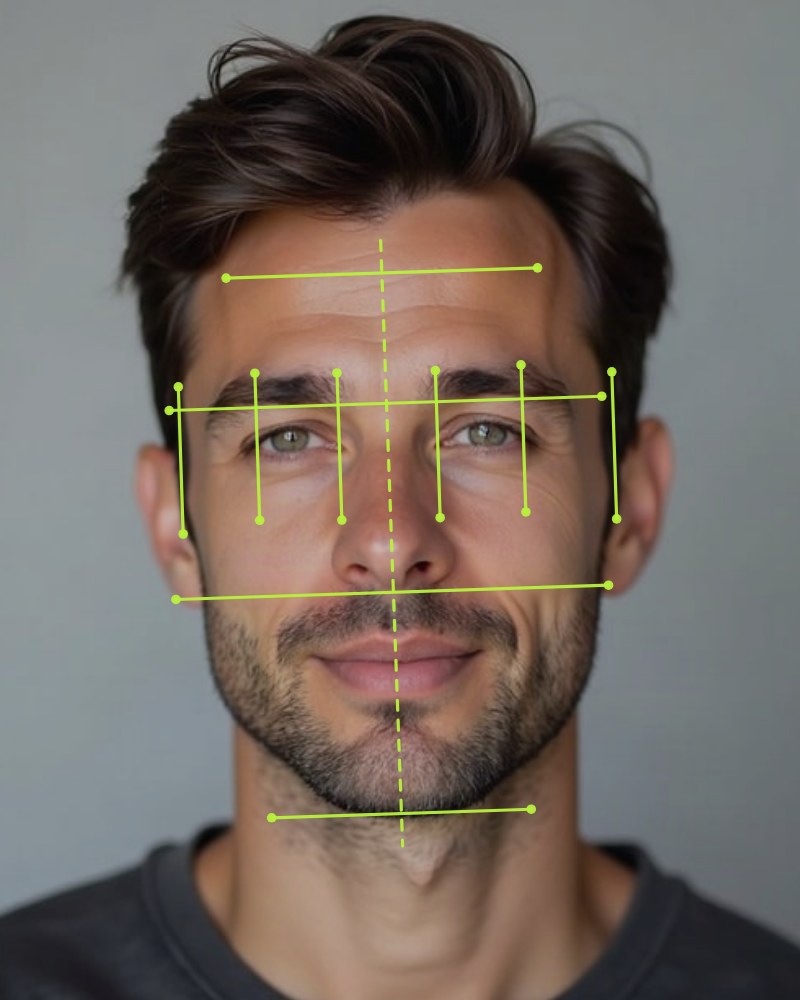
What downturned eyes are
Every eye has an inner corner by the nose and an outer corner toward the temple. Join them with a line and compare it with a level line across the face. When the outer end is lower, the eye is downturned; the measurement is called a negative canthal tilt. Downturned eyes often look soft, calm or thoughtful, and many people find the look gentle and warm.
Downturned describes shape, not tiredness or mood. The “sleepy” label sometimes attached to it comes from comparing it with makeup trends that lift the outer corner, not from anything about the eye itself.
How to tell if you have downturned eyes
The test finds both corners of each eye and the two pupils. It uses the line through the pupils as level, so a head tilted toward one shoulder does not change the answer, then measures the angle of each eye’s corner-to-corner line. Below −1° counts as downturned here; between −1° and +1° is neutral; above is lifted.
Expect a small number. The full-marks range for tilt in this test, the middle of its calibration faces, is +2.3° to +3.7°, so most faces in that set slope slightly up, and a reading of −2° is already clearly downturned. Your two eyes can differ by a degree or two; that is normal.
The camera matters more than anything. A phone held below your face, like a laptop camera, tips the reading toward downturned; one held above does the opposite. Hold the phone at eye level, keep a relaxed face and use the 3-shot selfie. The test only accepts uploaded photos that face the camera straight on and level, because a turned or tipped head changes the angle.
Downturned, hooded or droopy?
Downturned eyes often get confused with hooded eyes, where a fold of skin from the brow bone covers part of the lid. The two can occur together, but hooding is about the lid and tilt is about the corners. This test measures tilt only.
A drooping eyelid, one that sits low over the iris, is a different thing again. If one eyelid has changed recently, that is a question for an eye doctor, not a face test.
Common myths about downturned eyes
- “Downturned eyes need correcting.” They do not. Looks forums treat a lifted corner as the goal, but that is a fashion, and many admired faces have downturned eyes.
- “A negative reading proves it.” One photo from below can read negative on almost any face. Retake it at eye level before you believe it.
- “Exercises can lift the outer corner.” The corner position is set by bone and ligament. This page does not recommend surgery or any procedure to change it.
Makeup and glasses ideas for downturned eyes
Most makeup advice for downturned eyes lifts the outer third a little. Use as much or as little as you like:
- Liner: keep the line thin at the inner corner and thicker toward the outer third, and start the flick a little before the outer corner, angled up, so it does not follow the downward slope.
- Shadow: put the deepest shade on the outer third and blend it up toward the tail of the brow, not out and down.
- Lower lashes: keep liner and mascara light on the outer lower lashes, which otherwise trace the downward line.
- Upper lashes: curl them and concentrate mascara on the outer lashes; half lashes on the outer corner work well.
- Brows: a brow tail that ends level with or a little above where the brow starts balances the slope.
- Glasses: cat-eye and upswept frames, or frames whose top corners rise outward, add lift.
What downturned eyes look like in everyday terms
Picture the soft, slightly wistful gaze of a classic film lead: eyes that slope down a touch at the outer corners and look kind even at rest. Framed with soft brown liner and a straight brow, downturned eyes are a look of their own, no lifting needed.
Measure each eye separately with the canthal tilt test, compare with upturned eyes, or see how even your two eyes are with the face symmetry test.
If you want a name for the whole outline, not just the slope, the eye shape detector adds openness and spacing to the same tilt line.