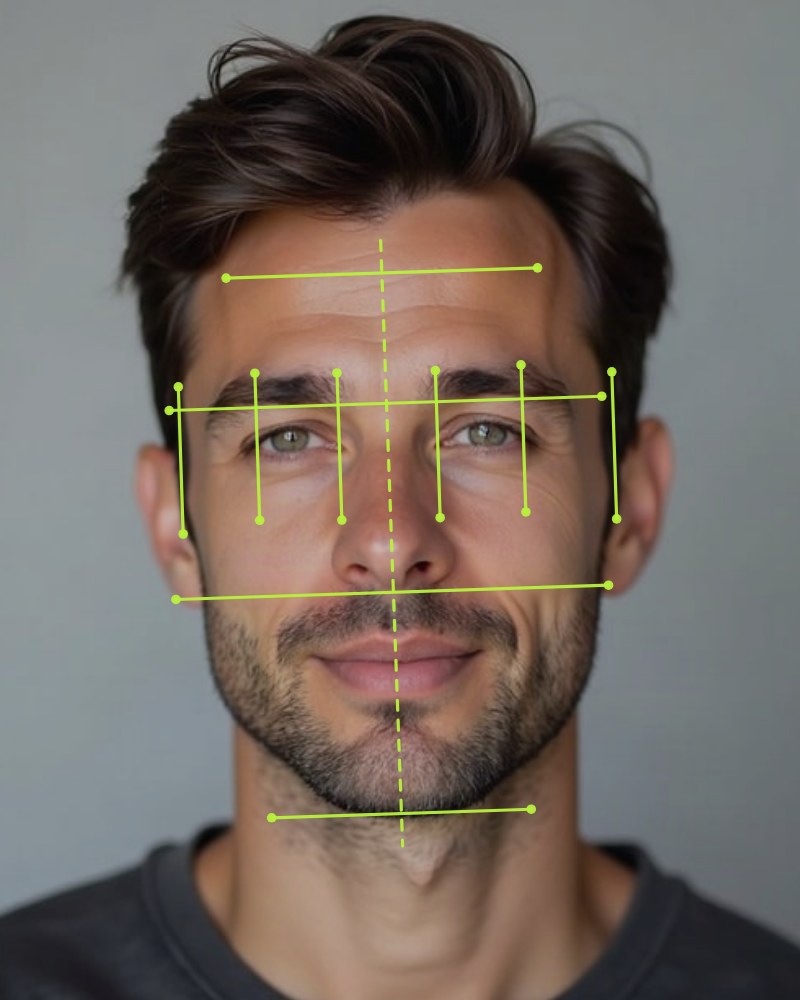
What an oblong face shape looks like
An oblong face is the long cousin of the oval. The outline still narrows slightly toward the chin, but the face is noticeably taller than it is wide, and the three widths are closer together, so the cheekbones do not stand out as a peak. Styling guides also call it “long” or, when the jaw is wide and angular, “rectangle”.
Long faces photograph with strong vertical lines and often show clear hollows under the cheekbones. In profile the shape tends to look elegant, which is one reason it turns up so often in fashion photography.
How to tell if you have an oblong face shape
The oblong profile has the highest length-to-width ratio of the six in this test: 1.26, against 1.19 for the middle of the calibration faces and 1.21 for oval. Its forehead (0.85) and jaw (0.90) sit close to the middle, and its chin angle is 127.1°, neither pointed nor flat.
Why does 1.26 count as long, when styling guides talk about a face one and a half times as long as it is wide? The camera model this test uses does not reach your hairline; its highest point is on the upper forehead. Every face loses the same slice of forehead, so all the ratios come out lower than a tape measure would give, and the comparison between shapes still holds. Just do not compare this number with a ruler measurement.
Mirror check: with your hair back, estimate the distance from hairline to chin and the width across your cheekbones. If the length is clearly the bigger number by a long way, and your jaw is nearly as wide as your cheekbones, oblong is likely.
Oblong or oval?
Oval is the nearest profile to oblong in this test, and the boundary between them is length. If your length row sits between oval’s 1.21 and oblong’s 1.26, you are between the two, and the result will name both. The second clue is the jaw: oblong keeps a wider jaw (0.90, against oval’s 0.89), so the lower face looks less tapered.
Diamond comes next. A long face with a narrow forehead and a pointed chin can read as diamond; if your cheekbones clearly stick out past both your temples and your jaw, read the diamond face shape page.
Common myths about the oblong face shape
- “A long face is a sad face.” The old idiom is about expression, not shape.
- “Oblong faces should never wear long hair.” Long hair with layers and some width at the sides suits many oblong faces; it is very straight, flat long hair that adds length.
- “Oblong and rectangle are different shapes.” Many charts split them by the jaw corner. This test treats both as oblong and shows your jaw number, so you can see which kind you are.
Hair, glasses and makeup ideas for an oblong face
Most ideas for long faces add width at the sides or break up the vertical line:
- Hair: fringes (straight or curtain), waves and curls at cheek level, bobs and lobs around the jaw. Keep height at the crown moderate if you want the face to read shorter. For short cuts, leave some fullness at the sides rather than shaving them close. The hairstyle finder measures how long your face reads and picks cuts that add width.
- Glasses: deep frames with tall lenses, oversized and aviator shapes cover more of the face’s height; frames with decorative or contrasting arms add width.
- Makeup: blush applied across the cheeks toward the ears, not lifted toward the temples. A touch of bronzer along the hairline and under the chin softens the length in photos.
- Beards: fuller at the sides than at the chin, so the face reads wider.
What an oblong face looks like in everyday terms
Picture a face with long, straight cheeks, a high forehead and a jaw that lines up under the cheekbones; casting notes often call it chiselled or aristocratic. That is the oblong outline.
Compare it with its closest neighbour on the oval face shape page, or measure all four widths with the face shape detector.